AI Resume Advisor
Not just polishing—it's a diagnosis. Know your chances before you apply.
Three Hours vs Six Seconds
Three hours. That's how long you spend tweaking your resume. Adjusting wording, optimizing layout, making sure every keyword is in place.
Six seconds. That's how long HR looks at your resume.
Then? Radio silence.
You tell yourself: the resume must not be good enough. So you revise it again, maybe even ask ChatGPT to polish it. Same result.
I've seen this cycle too many times. But I started to wonder: Is the problem really about "writing"?
Two Types of Gaps
There are actually two types of gaps between your resume and a job posting. Most people confuse them—and end up solving the wrong problem.
Presentation Gap: You have it, but didn't show it
You have the skill, but your resume doesn't convey it well.
For example, say you're a PM. You've led cross-functional projects, but your resume only says "tracked project progress and coordinated with team members." That's too vague—an intern could write the same thing.
Try this instead: "Managed 5 cross-functional projects using Jira, coordinating teams across Taiwan, US, and India, improving on-time delivery rate from 70% to 95%."
Same experience, completely different impact. In this case, AI writing tools can actually help.
Skill Gap: You really don't have it
You simply don't have that skill.
A Data Scientist role requires deploying ML models to production—you've only run them in Jupyter Notebook. A PM role needs Agile/Scrum certification and Monte Carlo simulation for risk assessment—you've never touched these tools.
No amount of polishing will help. You're missing the skill itself, not just the words.
Why Most Resume Tools Don't Work
Most resume tools—including asking ChatGPT to rewrite—only address the first problem. Polishing, keyword optimization, ATS formatting. These are fine, but they only solve half the problem.
What about Skill Gaps? No one tells you.
So you send 50 applications, get 2 responses. You think it's the wording, so you keep tweaking and applying. But the truth might be: you don't meet the core requirements of 80% of those jobs.
You keep polishing the key's appearance, not realizing it doesn't fit the lock.
The Right Order: Diagnose First, Then Act
Traditional approach: Write resume → Apply → Wait → Rejected → Revise → Apply again
The biggest problem? You never know what went wrong. Words? Skills? You can only guess.
But what if you flipped the order?
Diagnose gaps → Understand what's missing → Decide whether to apply → Prepare strategically
Before applying, you know your odds. You know which skills you have, which you lack. For what's missing, you know how to fill the gap.
How AI Resume Advisor Helps
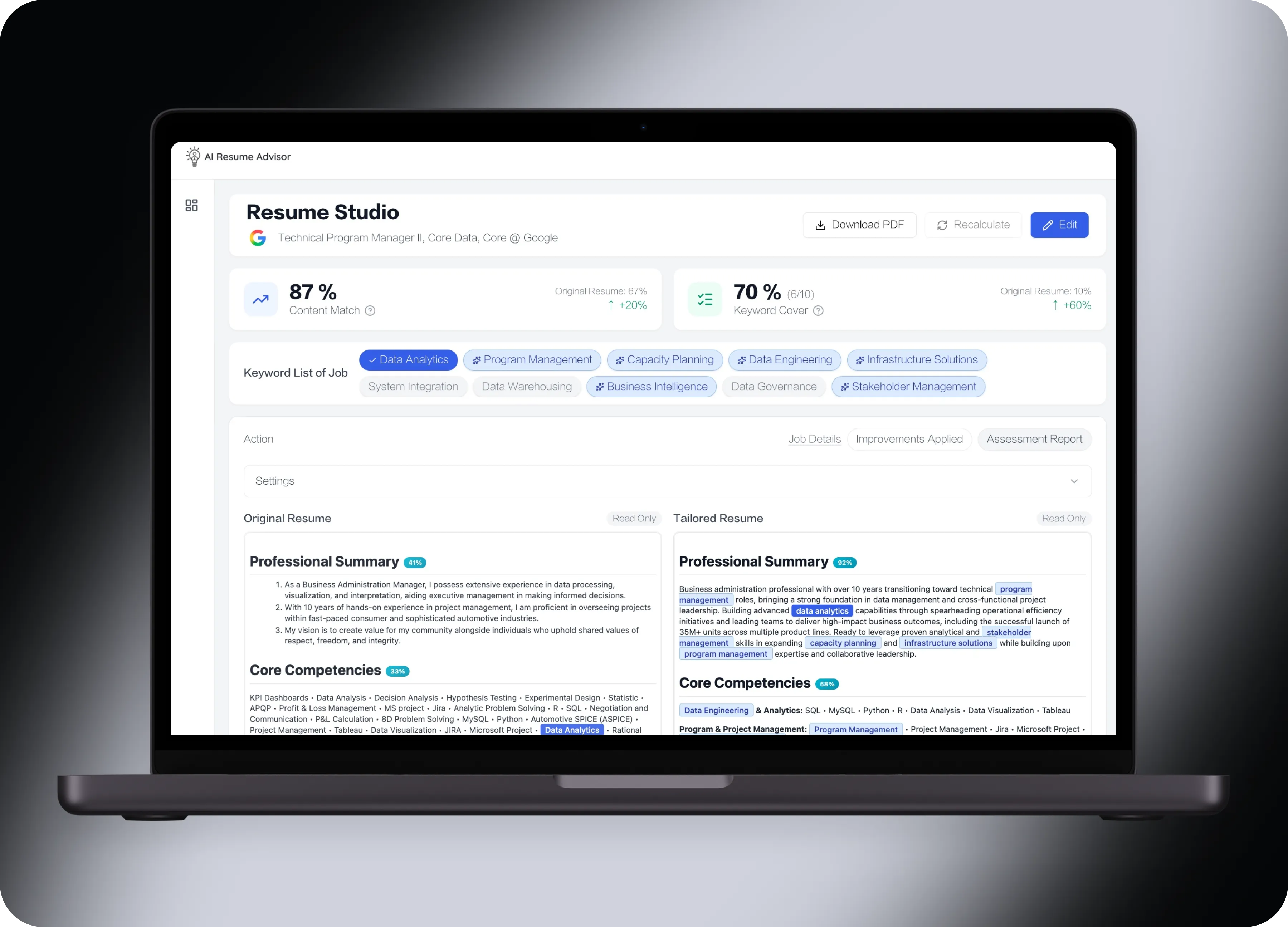
Step 1: See your match score in 3 seconds
When browsing LinkedIn jobs, our browser extension shows your match score instantly. No guessing—numbers tell the truth.
Step 2: Understand both types of gaps
Click for the full report (~30 seconds), and you'll see both gaps clearly separated:
- Presentation Gap: You have it but didn't express well → AI helps rewrite
- Skill Gap: You actually lack it → Recommended courses to fill the gap
Step 3: Build skills, not just polish words
For your Skill Gaps, we recommend online courses from Google, IBM, Meta, and top universities.
Think of it like a skill tree in a game. You can see where you are, where you want to go, and what skills to unlock in between. Only this time, it's for your real career.
Start Diagnosing Your Resume
3 seconds to see your match score, 30 seconds for the full diagnosis.
Go to AI Resume AdvisorWant to analyze directly on LinkedIn?
LinkedIn Resume Checker - Chrome Extension