This article is also available in Chinese閱讀中文版 →
Coursera Self-Learning Guide: Leverage Online Resources to Build Your Career

In my previous article, I shared how Coursera has helped me in my learning journey. Some readers reached out asking: “What exactly is Coursera? How can we best use it to develop our skills?”
Today, let’s dive deep into this online education platform that has transformed how countless people learn, and explore how it can help you achieve your career goals.
Coursera’s Vision and Mission
Coursera was founded in 2012 by two Stanford computer science professors, Andrew Ng and Daphne Koller. The platform’s vision is to “provide universal access to high-quality learning,” enabling everyone to access world-class educational resources, transform their lives, and drive social progress.
They achieve this vision by partnering with over 350 top universities and companies to provide diverse and flexible online learning opportunities for learners worldwide. The platform’s course ecosystem includes six main types: Individual Courses, Specializations, Professional Certificates, Guided Projects, Projects, and Degrees and Advancement Programs, designed to meet the needs of learners at different levels.
Choosing the Right Learning Path
Before starting your Coursera journey, consider your learning goals and needs. The platform offers various flexible learning options—let’s explore their features and ideal use cases.
Individual Courses
Individual courses are the most basic and flexible learning option, perfect for those looking to strengthen specific skills. For example, learners wanting to master Python programming can choose “Python Data Structures” and “Data Analysis with Python”. These courses typically cost $40-80 and most offer free audit options, allowing learners to experience the content before paying.
Specializations
Specializations provide a complete learning path for those seeking systematic mastery of a field. The “Generative AI for Data Scientists Specialization” is a great example, comprising three progressive courses: Introduction to Generative AI and Applications, Generative AI Prompt Engineering Basics, and Generative AI for Data Science Career Advancement.
“AWS Cloud Technical Essentials” provides technical professionals with an introduction to AWS cloud computing, covering core services like compute, storage, databases, networking, and security—helping beginners quickly grasp AWS fundamentals.
Specializations feature sequential, related courses that take learners from foundational theory to practical application, ultimately building comprehensive professional competence. They use a monthly subscription model, typically starting at $49/month, allowing learners to study at their own pace.
Professional Certificates
Professional certificate programs are designed for employment needs, and credentials from major tech companies are particularly valuable for job seekers. Take Google’s “Google Data Analytics Professional Certificate”—this course requires no prior background, starts from basics, and helps learners master data analytics skills within 6 months.
Similar options include Google’s “Google Project Management Professional Certificate” and IBM’s “Generative AI: Introduction and Applications”—all highly recognized in the industry. Professional certificate courses typically use a $39-49/month subscription model and award recognized certificates upon completion.
Hands-On Learning Options
Beyond traditional course formats, Coursera offers more hands-on learning options. Guided Projects allow learners to quickly master specific skills through practice—for example, “Spreadsheets for Beginners using Google Sheets” or “Build a Machine Learning Web App with Streamlit and Python”—quick-start projects that typically take just 2 hours to complete.
Projects offer deeper practical experience. Want to fine-tune a large language model yourself? “Finetuning Large Language Models” covers key LLM fine-tuning skills aligned with current AI industry demands, perfect for intermediate learners looking to quickly master practical techniques.
These hands-on courses not only help you build a professional portfolio but lay a solid foundation for your job search. Imagine being able to independently train a large language model, build practical applications, and deploy them to the cloud—this kind of practical ability becomes the most compelling proof of your qualifications for entering the AI industry.
Degrees and Advancement Programs
Coursera’s degree programs offer a new pathway to higher education. These courses are taught entirely by university professors and maintain rigorous academic standards. Take the University of Illinois’s “Master of Computer Science”—students can complete their studies in 2-3 years without leaving their jobs, at just one-third the cost of traditional master’s programs.
The University of Michigan’s “Master of Data Science” combines theory and practice, with industry mentor guidance. Upon completion, students receive the same degree certificate as on-campus students. These degree programs are typically charged per credit, with a complete master’s degree costing around $20,000.
For learners not wanting to commit to a full master’s program, schools offer flexible alternatives. Michigan’s “Applied Data Science MasterTrack® Certificate” lets learners complete part of the master’s coursework and earn a certificate, with credits recognized if they later decide to pursue the full degree.
Popular Coursera Courses
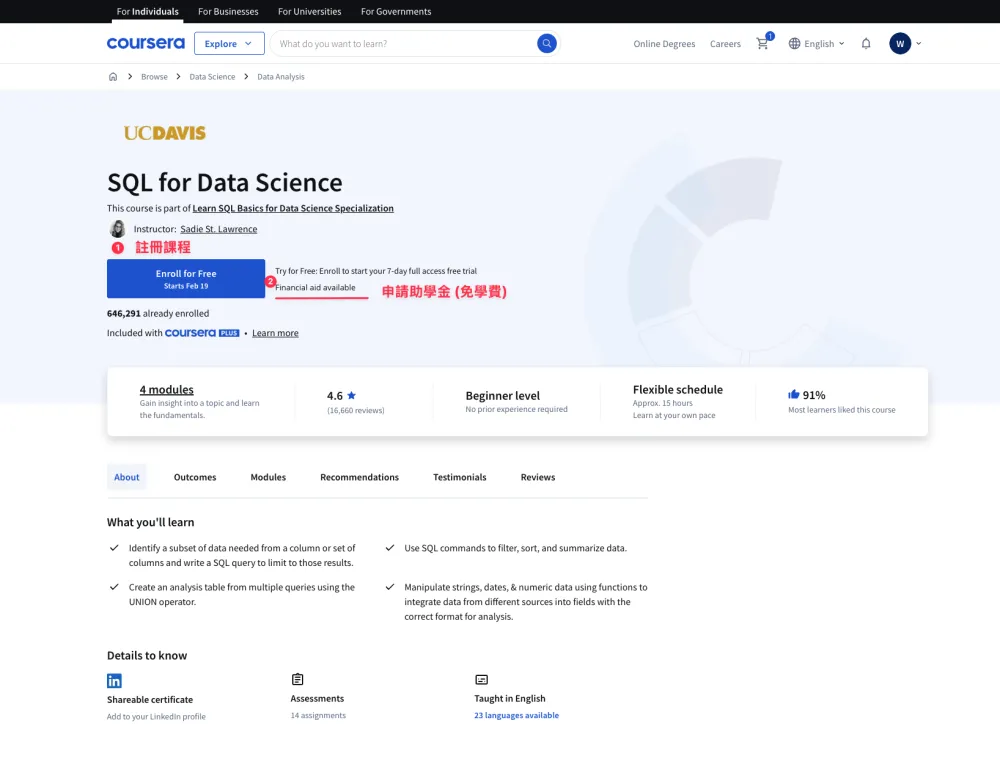
Based on Coursera’s enrollment numbers and ratings, here are some of the platform’s most popular courses. This data comes from public course page information.
Top Individual Courses
| Course Name | Provider | Duration | Key Features | Rating |
|---|---|---|---|---|
| Learning How to Learn | Deep Teaching Solutions | 4 weeks | Most popular learning methodology course, practical techniques | 4.8/5 |
| Programming for Everybody | University of Michigan | 8 weeks | Python for absolute beginners, clear explanations | 4.8/5 |
Recommended Specializations
| Specialization Name | Provider | Course Count | Key Features | Rating |
|---|---|---|---|---|
| Deep Learning | DeepLearning.AI | 5 courses | Most comprehensive AI course series, theory meets practice | 4.9/5 |
| Data Science Foundations | IBM and University of London | 8 courses | Complete data science training, IBM tools hands-on | 4.8/5 |
| Excel Skills for Business | Macquarie University | 4 courses | Essential workplace Excel skills, basic to advanced | 4.8/5 |
Popular Professional Certificates
| Certificate Name | Provider | Duration | Career Path | Rating |
|---|---|---|---|---|
| Google Data Analytics | 6 months | Data Analyst, Business Analyst | 4.8/5 | |
| Meta Front-End Developer | Meta | 7 months | Front-End Engineer, Web Developer | 4.7/5 |
| IBM Data Analyst | IBM | 5 months | Data Analyst, BI Analyst | 4.8/5 |
These courses not only have excellent ratings but have stood the test of time, helping countless learners achieve their career goals. The benefit of choosing popular courses is that you can learn from extensive learner reviews about pros and cons, while also finding more peers for mutual support in discussion forums.
The Special Value of Enterprise Certifications
Among the many learning options, enterprise-provided professional certifications deserve special attention. Google’s Career Certificate program is a great example. This program requires no related background or degree, focusing entirely on practical skill development. Most learners need just 3-6 months, investing about 10 hours per week, to complete full professional training.
Notably, Google has established an employer consortium of over 150 companies for its certificate programs—these companies commit to considering certificate holders’ job applications. Course content directly aligns with actual workplace needs, making it valuable in the job search process.
IBM and Meta (Facebook) certification courses each have their own strengths. IBM courses emphasize deep technical training, incorporating enterprise real-world experience. Meta courses let learners gain insight into top tech companies’ development practices and engineering culture—invaluable experiences that typical educational courses can’t provide.
Learning Experience and Support System
Coursera’s learning experience far exceeds traditional online courses. The platform uses diverse teaching methods, combining video lectures, interactive exercises, peer assessments, and group discussions. All course content includes full subtitle support, with many popular courses available in multiple languages. The mobile app lets learners make full use of spare time, while discussion forum interactions compensate for the interpersonal exchange that online learning might otherwise lack.
My Coursera Learning Experience
In my experience using Coursera, I’ve found it to be an incredibly practical learning platform. However, my approach might differ from most people’s. I don’t follow courses from start to finish—instead, I use it as an on-demand knowledge support system.
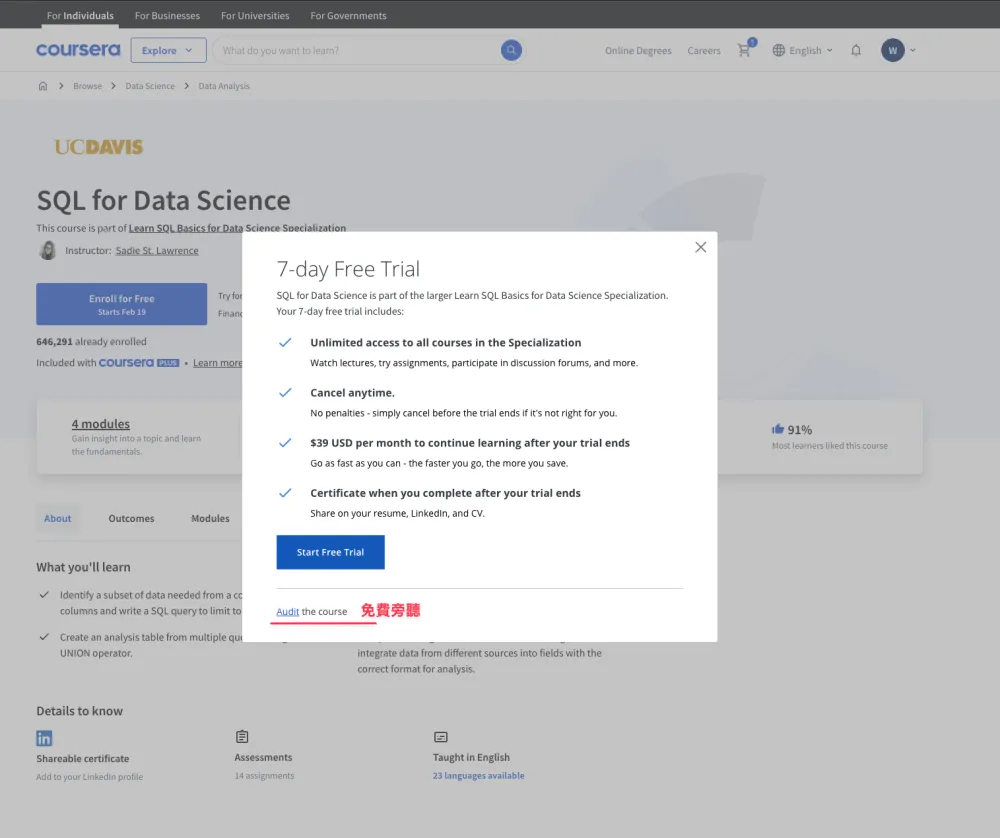
When I hit bottlenecks at work or in my studies—whether dealing with a specific data analysis problem or needing to learn a new technical tool—I first search Coursera for relevant course resources. Through free auditing, I can quickly find the knowledge I need, which is far more efficient than aimlessly searching YouTube.
Here’s a concrete example: while preparing for my school thesis project, I needed to build a machine learning pipeline on Azure cloud platform that could receive data via HTTP trigger and return analysis results. This was a completely new challenge for me. I found a relevant hands-on project course on Coursera and quickly mastered the implementation through practice. This targeted learning approach not only saved time but directly solved my actual problem.
Bridging Skill Gaps and Boosting Job Market Competitiveness
In today’s job market, ATS (Applicant Tracking Systems) have become standard tools for companies to screen candidates. Many job seekers try using AI tools like ChatGPT to optimize their resumes, but this has fundamental limitations: while AI can help express our experience more precisely using industry terminology, it cannot create skills we don’t actually have.
When core competencies required for a position—like Python programming, data analysis, or machine learning—are completely absent from your work experience, no amount of clever wording can improve your ATS match rate. This is the bottleneck of relying solely on AI tools for resume optimization—the problem isn’t the expression format, but the skill gap itself.
Coursera provides an ideal solution for bridging these skill gaps. The platform offers numerous professional certifications designed by industry giants like Google Data Analytics and IBM AI Engineering—each course includes hands-on projects. The core value of these courses isn’t theoretical knowledge but the practical opportunities they provide. Upon completion, you don’t just have an empty certificate—you have demonstrable technical results. In interviews, these experiences let you discuss technical details in depth and confidently handle challenging questions, far surpassing competitors who lack practical experience.
If you can systematically accumulate relevant skills in the year before a career change, while completing professional certifications and hands-on projects to build a complete “learning → practice → certification” journey, you’ll impress hiring managers far more than simply submitting resumes. From personal experience, through the “Finetuning Large Language Models” course, I not only mastered the technology to independently train large language models but successfully deployed them to the cloud and developed practical AI applications. These hands-on experiences aren’t just learning outcomes—they became the most compelling professional proof in my job search.
Moreover, these professional skills open unlimited possibilities for entrepreneurship and side businesses. Once you master these capabilities, whether freelancing, building a personal brand, or launching independent side projects, you’ll be well-equipped to create diverse career development paths.
Conclusion: Choose Your Learning Path
In this era of rapidly evolving skills, mastering efficient learning channels has become increasingly important. Coursera not only provides rich course content but creates a complete solution from learning to employment. Through flexible learning methods and affordable (or even free) pricing, it makes lifelong learning accessible to everyone.
Take action now! Whether you want to boost your workplace competitiveness, change careers, or simply satisfy your curiosity about a field, head to Coursera and explore the learning path that’s right for you. In the digital age, learning is never an endpoint—it’s a journey of continuous growth. Time invested in self-improvement today will pay dividends many times over in the future.
Enjoyed this? Connect with me on LinkedIn — I’m open to collaboration, consulting, and new opportunities.