Claude Certified Architect & Anthropic's 4 Certifications:Cost, Format, and How to Register (2026)
You cannot register for a Claude certification with a personal email. Who is eligible, which of the 4 exams fits your role, and what each costs.
Contents
- 01The Four Claude Certifications
- 02Free Course Certificates vs. Paid Proctored Exams
- 03Why Four Credentials
- 04Common Rules Across All Four Credentials
- 05Claude Certified Architect - Foundations: The Exam in Detail
- 06A Note on Abbreviations: CCAF, CCA-F, and CCAR-F
- 07How to Decide Whether This Is Relevant to You
- Sources
For years, the AI certification landscape belonged to the cloud vendors. Microsoft launched Azure AI Engineer. Google built out its Cloud AI track. AWS introduced the AI Practitioner. All of them test knowledge of a specific platform — how to configure a service, how to route a request through an API, how to use the vendor’s tooling to wrap a model someone else built.
2026 brought a different category: the model vendors themselves started issuing credentials. And the first frontier lab to ship a complete, proctored certification program is not OpenAI. It is Anthropic — whose flagship credential, the Claude Certified Architect, has been live since March.
| Anthropic (Claude) | OpenAI (ChatGPT) | Google (Gemini) | |
|---|---|---|---|
| Proctored professional certification | Available — four credentials, Pearson VUE | Not yet — announced and in enterprise pilots; no individual registration as of July 2026 | Model vendor does not have one; AI certifications sit under Google Cloud |
| What you can get today | CCAO-F / CCDV-F / CCAR-F / CCAR-P ($99–$175) | OpenAI Academy free course-completion certificates (no proctoring) | Google Cloud GenAI Leader ($99, Pearson VUE) and other cloud-track credentials |
Two distinctions worth making precise. OpenAI’s current certificates prove you finished a course, not that you passed an exam. Google does run proctored exams, but the issuing entity is the cloud division, and the subject matter is operating AI services on Google Cloud infrastructure — not the Gemini model ecosystem itself.
The organization that has built “model vendor issues the question, third party proctors the test” into a complete running system is Anthropic, the enterprise-focused lab behind Claude.
In March 2026, Anthropic launched its first credential alongside the Claude Partner Network. The launch announcement included a line that did not get much attention: “Later this year, we’ll introduce additional certifications for sellers, architects, and developers.” Four months later, that later arrived. One credential became four.
The Four Claude Certifications
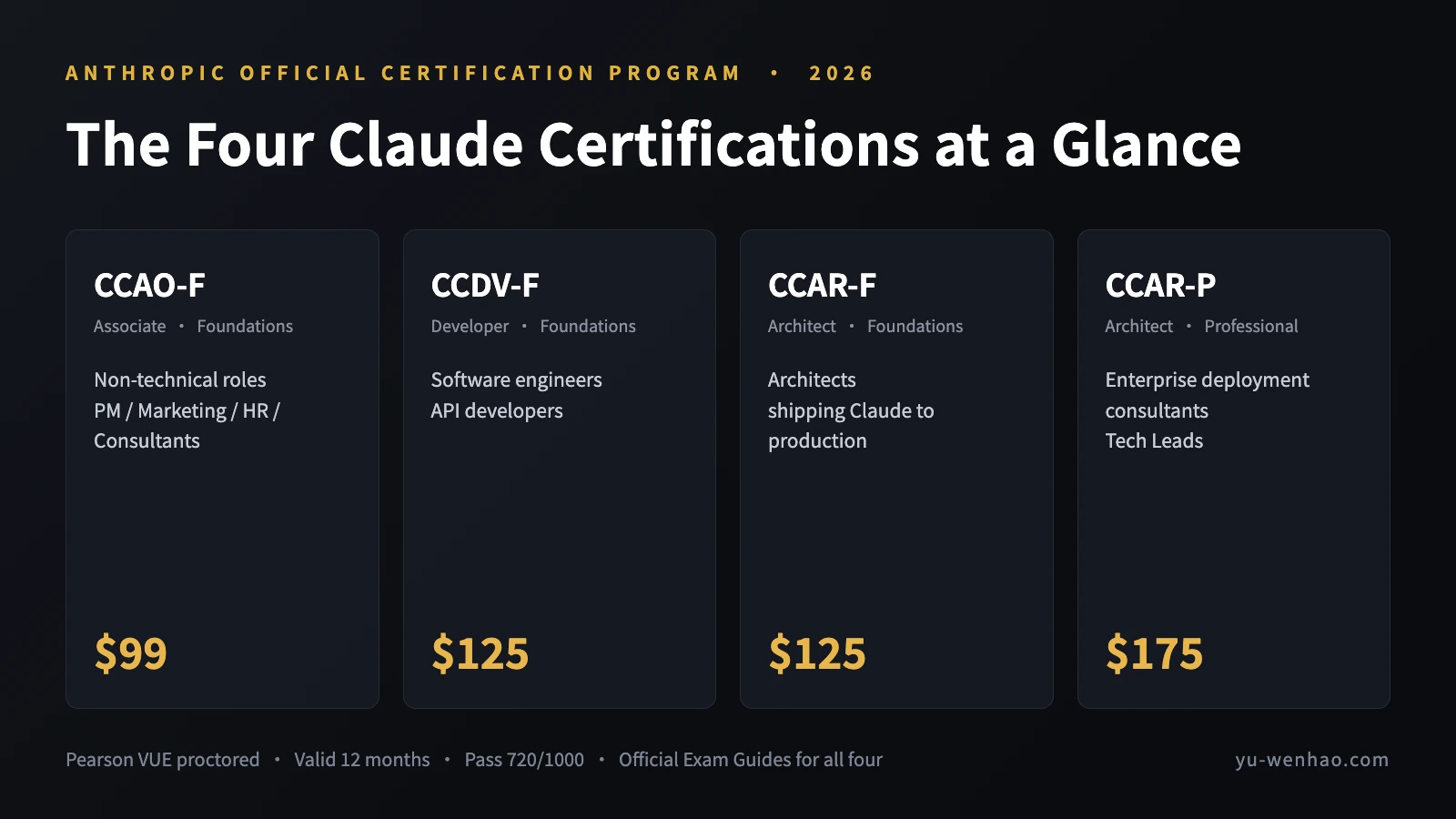
Anthropic’s program currently has four credentials. Specifications are per the official Pearson VUE page and Anthropic Partner Academy FAQ:
| Credential | Abbreviation | Who it is for | Price | Live since | Official Exam Guide |
|---|---|---|---|---|---|
| Claude Certified Associate - Foundations | CCAO-F | Non-technical roles: PM, marketing, HR, consultants (no coding required) | $99 | 2026-07-13 | Available |
| Claude Certified Developer - Foundations | CCDV-F | Software engineers, API developers | $125 | 2026-07-13 | Available |
| Claude Certified Architect - Foundations | CCAR-F | Architects, anyone deploying Claude applications to production | $125 | 2026-03-12 | Available |
| Claude Certified Architect - Professional | CCAR-P | Enterprise deployment consultants, Tech Leads | $175 | July 2026 | Available |
These are official list prices per Anthropic Partner Academy FAQ. There are no prerequisite locks between credentials — you can sit for any of the four directly. Official Exam Guides for all four credentials are now downloadable from the Partner Academy certifications page; role positioning and exam scope are authoritative per each guide. The July opening dates still come from third-party reporting.
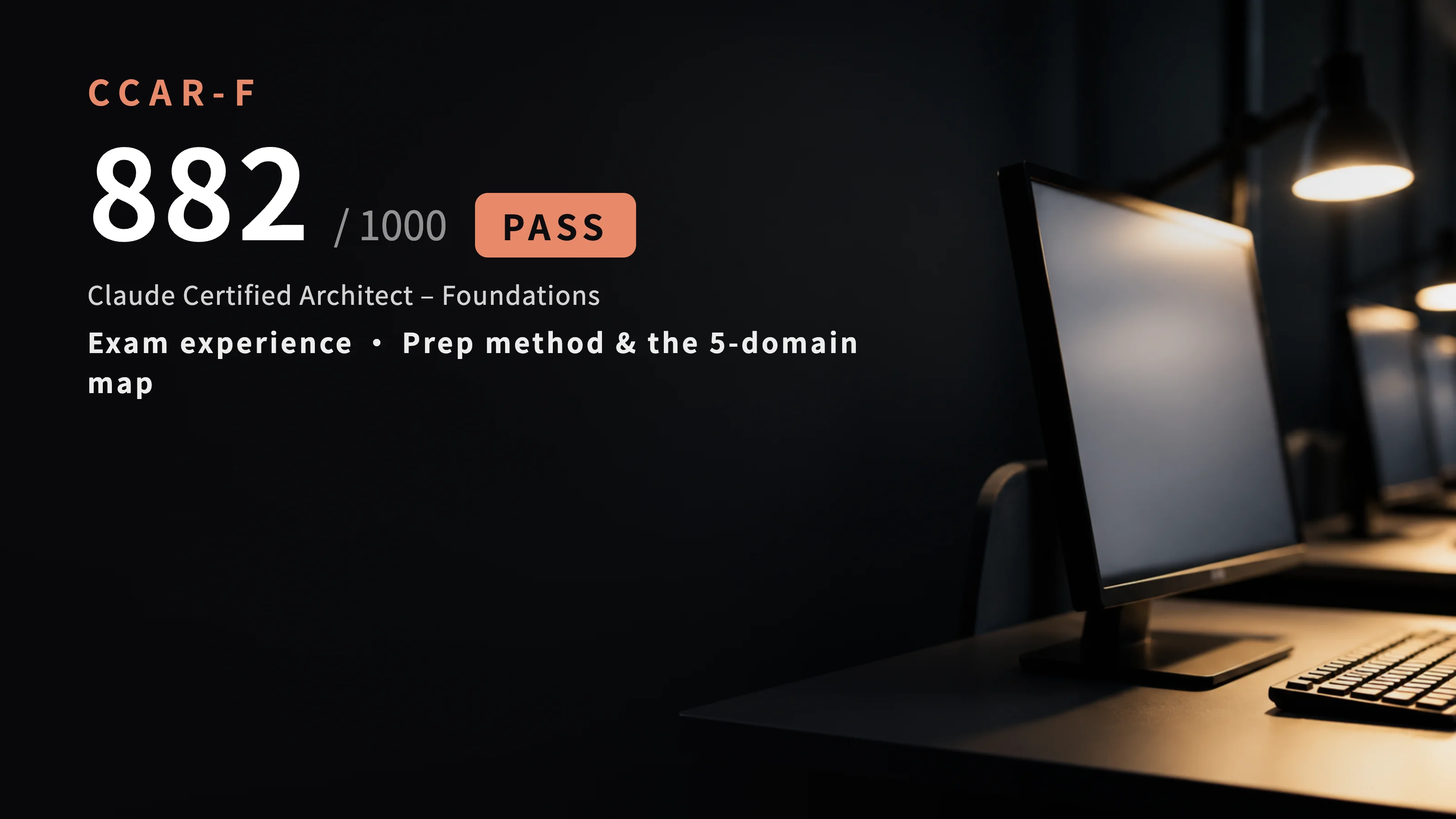
(Update, Aug 29, 2026: I have since taken CCAR-F myself and passed with 882/1000. The firsthand prep method, domain map, and test-day walkthrough are in my CCAR-F exam experience.)
Free Course Certificates vs. Paid Proctored Exams
Before going further, there is a distinction that keeps getting muddled in the press, and it is worth settling.
Anthropic’s official course catalog hosts more than twenty free courses — from Claude Code in Action, Introduction to Model Context Protocol, and Building with the Claude API to the non-technical AI Fluency series. Complete one and you receive a course-completion certificate. These have circulated widely on social media under the headline “free Claude certificates.”
Those course-completion certificates are not the same as CCAO-F, CCDV-F, CCAR-F, and CCAR-P.
The free certificates have no proctoring, no standardized passing threshold, and no Credly badge. The four paid credentials are standardized exams delivered through Pearson VUE with a global scoring system. When someone mentions an “Anthropic certification” in a professional context, it is worth confirming which one they mean.
Why Four Credentials
Anthropic designing four distinct credentials rather than one general test is worth pausing on. It is the first public statement from the lab that different roles in an AI deployment have meaningfully different knowledge requirements.
The most notable credential in this respect is the Associate tier. A PM evaluating model output quality, a compliance officer drafting governance policy, an HR manager planning internal training — Anthropic built a credential for these roles. That decision frames AI adoption as an organizational challenge, not only an engineering one.
The program’s shape reflects how Anthropic is building its enterprise business: the certifications map to roles that appear in real implementation projects, from the non-technical stakeholder who makes the buy decision through to the architect who keeps the system running in production.
Common Rules Across All Four Credentials
According to the Anthropic Partner Academy FAQ (the primary source on certification policy):
All four exams are delivered through Pearson VUE, either online-proctored or at a test center. Passing earns a Credly digital badge. The passing score is 720 out of 1000, on a scaled 100–1,000 range.
Credentials are valid for 12 months. (Certifications earned before June 30, 2026 under the previous six-month validity policy were automatically extended to 12 months from the original date of issue.) Renewal within the validity window is free and non-proctored, handled through an assessment on Partner Academy. Letting a credential lapse means paying the full exam fee again.
Retake waiting periods: 14 days after a first failed attempt, 30 days after a second, 90 days after a third. The same exam can be taken at most four times in any rolling 12-month period.
One practical constraint: registration requires Partner Network membership. A personal email address will be blocked at checkout. To register, pay, and schedule through Pearson, a candidate must use an account connected to a partner organization’s Partner Academy. Individuals who want to sit an exam need access through an organization already in the Partner Network. If that is the wall you are hitting, the end of my CCAR-F exam experience explains how I can help.
Claude Certified Architect - Foundations: The Exam in Detail
All four credentials now have official Exam Guides, downloadable from the Partner Academy certifications page. (Update, July 22, 2026: the original version of this article stated that only CCAR-F had a published guide; the other three went live around the July exam launch, and this section and the table above have been corrected.) The Architect - Foundations guide was published first, and “Claude Certified Architect” is where searches most often point, so it merits proportionally more space here.
Exam format: 60 questions, a mix of multiple-choice and multiple-response items — each item states how many responses to select. Passing score: 720.
The exam’s logic has two layers. The five domains define what is tested — the scoring blueprint, per the official Exam Guide:
| Domain | Weight |
|---|---|
| Agentic Architecture | 27% |
| Claude Code Configuration | 20% |
| Prompt & Structured Output | 20% |
| Tool Design & MCP | 18% |
| Context & Reliability | 15% |
Under each domain, the guide breaks the material into individual objectives — one-line statements of what you should be able to do — and the post-exam score report breaks your results down against those objectives, so a candidate can see exactly where the gaps are.
The six scenarios define how it is tested. Questions are not terminology quizzes — they drop you into a production project: Customer Support Agent, Code Generation, Multi-Agent Research, Developer Productivity, CI/CD, and Structured Data Extraction. Each exam draws four of the six at random.
Here is how the layers mesh. Draw the Customer Support Agent scenario, and a question might hand you this setup: a Claude-based support agent with three tools — look up an order, process a refund, escalate to a human. Then it asks whether an action that must never misfire, like a refund, should be enforced with a hard programmatic block or left to prompt instructions. The scenario is the wrapper; the score lands on Tool Design and reliability objectives. The test is not whether you know the terminology but whether you can make sound architectural decisions in concrete deployment contexts.
For anyone preparing for the CCAR-F: the official Exam Guide is publicly available and is a better use of study time than any third-party prep site. It contains the full task statements for each domain.
A Note on Abbreviations: CCAF, CCA-F, and CCAR-F
If you have searched for the Architect - Foundations credential before, the three different abbreviations you have likely encountered are not errors by three different sources. They represent three moments in the credential’s history.
When Anthropic launched the credential in March 2026, the announcement used the full name without a formal abbreviation. Anthropic’s own follow-up communications — including an official email and a short URL at clau.de/CCAF — used CCAF. Community discussion and press coverage mostly settled on CCA-F. (You will also see it written as “Anthropic Certified Architect” in job posts and course listings — same exam.)
In July 2026, when the program expanded to four credentials and the exams moved to Pearson VUE’s catalog, the Architect - Foundations credential was assigned the formal exam code CCAR-F. The R distinguishes it from the Associate credential, which received the code CCAO-F (O for Associate). No official rename occurred; CCAR-F is simply the Pearson VUE catalog code that was created at that point.
All three abbreviations refer to the same credential. For anything external-facing — a LinkedIn certification entry, a resume — CCAR-F is the current official code.
How to Decide Whether This Is Relevant to You
The practical question is whether your organization or your clients are operating in the Anthropic ecosystem. If they are, the credential that matches your role is worth considering: CCAO-F for non-technical operators, CCDV-F for developers building on the API, CCAR-F or CCAR-P for architects managing production Claude deployments.
The broader point about certifications applies here as it does elsewhere: a credential carries weight in proportion to the market that recognizes it. Cloud vendor certifications command real rates partly because clients can read them on a resume and know what system was tested. Anthropic is building toward the same dynamic — the Partner Network and the certification program are designed together, which means the credentials will matter most in contexts where the Partner Network itself matters.
For the cloud vendor tier (Microsoft / Google / AWS), proctored AI credentials have been established long enough to show up in RFP requirements and hiring filters. For model vendor credentials, that part of the market is just forming. The Anthropic program is the furthest along.
Sources
- Anthropic — Claude Partner Network launch announcement (March 12, 2026)
- Anthropic Partner Academy — Certification FAQ: pricing, validity, retake policy
- Anthropic Partner Academy — Certifications page with official Exam Guides for all four credentials
- Pearson VUE — Claude Certification Program
- Anthropic — Free course catalog (Skilljar)
- Big Tech Careers — Anthropic Expanded the Claude Certification Track (July opening dates)
- OpenAI — Certificate Courses
- Google Cloud — Generative AI Leader certification
- AWS — Certified AI Practitioner
Want to sit one of these exams but have no registration path? Leave your contact here, and I’ll reply personally.
Enjoyed this? Connect with me on LinkedIn — I’m open to collaboration, consulting, and new opportunities.

WenHao Yu余文皓
Claude Certified Architect. Founder of Confluence Partners, helping companies adopt AI through consulting and training.
About →Related articles